

Skip to Main Content
All News

From plant-based ingredients to functional beverages:

Date

Jun 24, 2026

Type

Project Successes

Sector

Food and Beverage

Date

Jun 24, 2026

Type

Project Successes

Sector

Food and Beverage

Do you have an innovation in mind? A project to discuss?

To learn more about our services, contact:

David DiPietro
Business Development Manager
[email protected]

Visit our website to learn more!

Company partners with NC’s Food and Beverage Innovation Centre to bring concept to life

The food and beverage industry is changing quickly inside grocery stores across North America.

Consumers are increasingly looking for products that do more than taste good. They want higher protein, added fibre, reduced sugar, clean labels and ingredients that align with evolving health and wellness trends, all without sacrificing flavour or experience.

For Edmonton-based raw ingredient supplier Top Health Ingredients, those shifts are not just trends to observe. They are opportunities to innovate.

Founded in 2009, Top Health Ingredients supplies functional plant-based ingredients to food and beverage companies across North America, including proteins, fibres and prebiotics, sweeteners and functional mushrooms used in a growing number of consumer products. Over the last 17 years, the company has watched the market evolve from a niche interest in plant-based products into a broader demand for functional foods and beverages.

Angela Billingsley, Product Development and QA Specialist at Top Health Ingredients, said consumers are becoming much more educated about what goes into the products they buy.

“Years ago, people were mostly focused on whether something was plant-based,” said Billingsley. “Now they’re looking at things like protein quality, fibre content, reduced sugar and overall functionality while still expecting products to taste good.”

That demand for functionality led Top Health Ingredients to explore a new direction: a carbonated functional beverage prototype that could showcase several of its ingredients in a clean, refreshing and consumer-friendly format.

We had created beverages before, but not to the point where we were producing something in a facility that allowed for carbonation, canning and full-scale-up processing.

Angela Billingsley, Product Development and QA Specialist, Top Health Ingredients

While the company regularly develops internal prototypes such as protein bars, energy bites and smaller beverage concepts, creating a carbonated beverage that could be processed, canned and scaled commercially required expertise and equipment beyond its in-house capabilities.

“We wanted to create something outside of what we normally produce,” said Billingsley. “We had created beverages before, but not to the point where we were producing something in a facility that allowed for carbonation, canning and full-scale-up processing.”

The project also reflected Top Health Ingredients’ broader focus on innovation and quality. In addition to sourcing and supplying ingredients, the company works closely with customers to help them understand how ingredients perform in real applications.

“We do a lot of testing and troubleshooting with customers because some of these ingredients are still very new to the market,” said Billingsley. “We’re always looking at how they perform, how they taste and how they can be incorporated into products consumers will actually enjoy.”

Billingsley said the perception of plant-based products has also changed significantly.

“There was a time when people expected plant proteins to taste gritty or have off flavours,” she said. “But the processing and refinement behind these ingredients has improved tremendously. Consumers now expect plant-based products to taste just as good as anything else on the shelf.”

Bringing the beverage concept to life

To help bring the idea to life, Top Health Ingredients partnered with Niagara College’s Food and Beverage Innovation Centre (FBIC), part of Niagara College’s Research and Innovation division.

After researching organizations across Canada that support beverage scale-up and product development, Top Health Ingredients connected with the FBIC team.

“What really stood out to us was how knowledgeable and collaborative the team was right from the beginning,” said Billingsley. “We met with Lyndon and Ana, talked through the project and the possibilities, and it felt like they really understood what we were trying to achieve.”

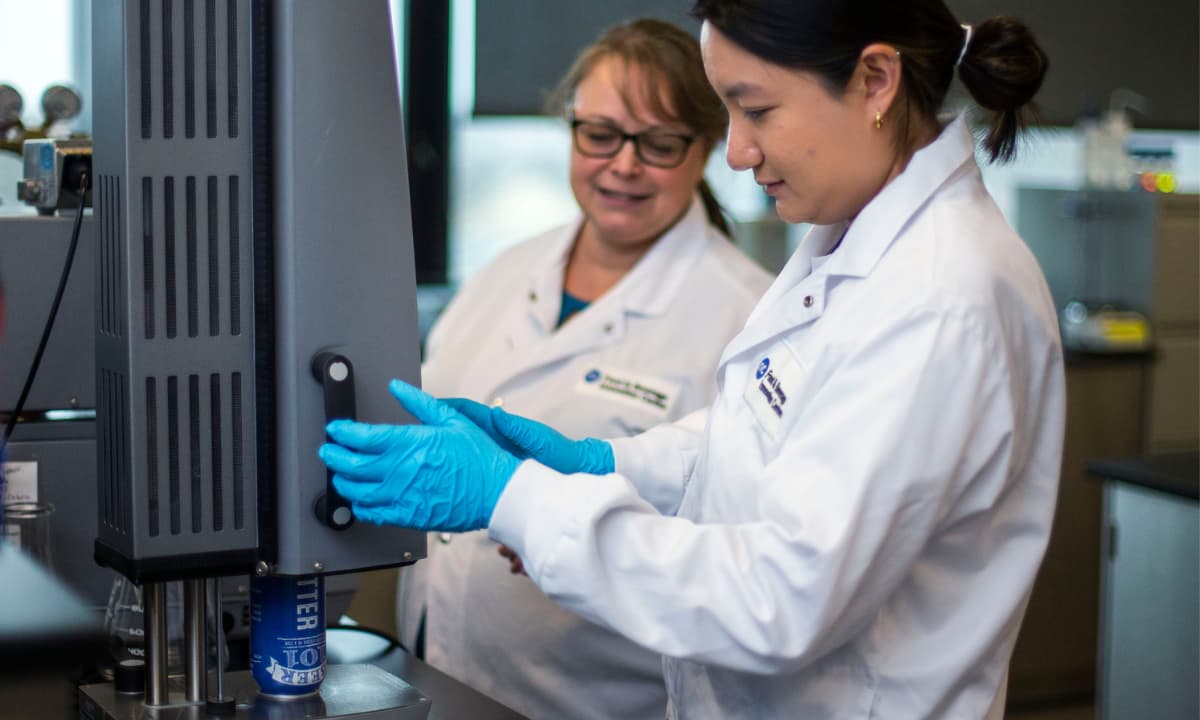
The company was also impressed by FBIC’s upgraded facilities and the centre’s ability to support both formulation and processing at a larger scale through its HACCP-certified beverage processing facility.

“We can do benchtop work internally, but Niagara College had the scale-up capabilities and the equipment we needed to really test the product properly,” said Billingsley. “That was a huge advantage for us.”

“Projects like this are exactly where FBIC can help industry partners move from an idea to something tangible,” said Dr. Ana Cristina Vega Lugo, Scientific Manager of FBIC. “Top Health Ingredients came to the project with a clear understanding of their ingredients and their market opportunity, and our role was to help test, refine and scale that concept in a way that supported their goals.”

Projects like this are exactly where FBIC can help industry partners move from an idea to something tangible. Top Health Ingredients came to the project with a clear understanding of their ingredients and their market opportunity, and our role was to help test, refine and scale that concept in a way that supported their goals.

Dr. Ana Cristina Vega Lugo, Scientific Manager, FBIC

The prototype beverage focused on exploration flavour profiles in combination of  functional ingredients and alternative sweeteners  into a carbonated drink that remained clean, refreshing and approachable for consumers.

“We wanted to see how the ingredients would behave in a real-world beverage application,” said Billingsley. “Things can look one way during small benchtop testing, but when you actually scale up production and process the beverage, you start learning much more about how everything works together.”

The collaboration between FBIC and Top Health Ingredients involved extensive back-and-forth development, including brainstorming flavour profiles, reviewing products currently on the market and refining formulations through multiple iterations.

Billingsley began by visiting local grocery stores to see what was already on shelves and better understand consumer-facing beverage trends.

“We talked about flavour direction, sweetness levels and the overall experience we wanted consumers to have,” she said.

From there, FBIC developed initial formulations and shipped samples to Edmonton for review.

“There was a lot of communication throughout the process,” said Billingsley. “They would send samples when they felt something was close to what we were looking for, we’d discuss it together, provide feedback and then continue refining things from there.”

Despite being located on opposite sides of the country, the partnership remained highly collaborative through regular virtual meetings, shipped samples and ongoing communication.

“It honestly went really smoothly considering we’re halfway across Canada from each other,” said Billingsley. “The team knew what they were doing, so the process felt very seamless.”

“Even with the company located in Edmonton, the collaboration was highly hands-on and iterative,” said Lyndon Ashton, Associate Director, Economic Development and Planning for FBIC. “Through regular communication, sample development and feedback, we were able to support the formulation process and help Top Health Ingredients create a prototype they could confidently showcase to customers and industry partners.”

For Billingsley, one of the most valuable parts of the collaboration was the opportunity to travel to Niagara College and observe the beverage scale-up process firsthand.

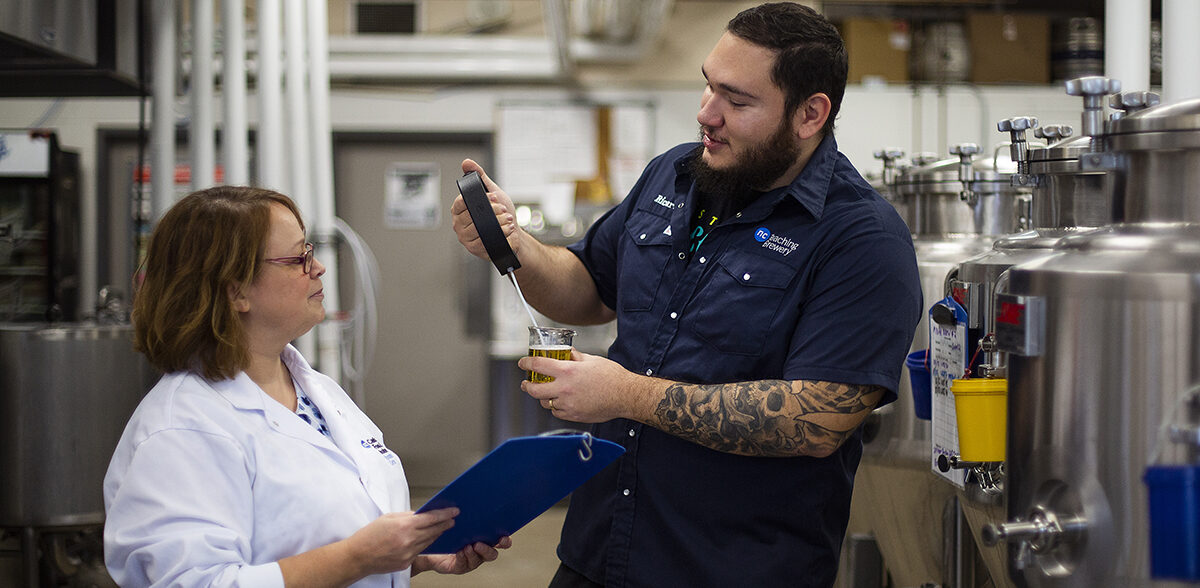
During the visit, she toured FBIC’s facilities and watched the product move through mixing, carbonation and canning.

“I got to see the entire process in action, which was amazing,” said Billingsley. “I’m someone who really enjoys learning and understanding how different manufacturing processes work, so being able to see everything firsthand was incredibly valuable.”

The visit also gave her a stronger understanding of beverage manufacturing that she could bring back to Top Health Ingredients’ customers and future projects.

“When customers ask questions about beverage applications now, I can speak from experience because I saw the process myself,” said Billingsley. “I can confidently recommend Niagara College and say they were great to work with.”

From prototype to future possibilities

The final beverage prototype was later showcased at SupplySide Global 2025, helping demonstrate how Top Health Ingredients’ functional ingredient solutions could perform in a finished consumer-ready application.

Beyond the final prototype, the project reinforced how applied research collaborations can help businesses test new ideas, reduce risk and accelerate innovation.

“There’s definitely a huge benefit to working with an organization like FBIC,” said Billingsley. “They guide you through the process step by step, and because the team has so much expertise, it makes everything much more efficient than trying to do it entirely on your own.”

Billingsley also pointed to the accessibility of support programs and funding opportunities available through innovation partnerships as an important factor for companies exploring research and development.

“There are funding opportunities available that really help make these types of projects possible,” she said. “That support allows companies to explore ideas they may not otherwise be able to.”

“There are funding opportunities available that really help make these types of projects possible. That support allows companies to explore ideas they may not otherwise be able to.”

Angela Billingsley

Looking ahead, Top Health Ingredients is already considering future concepts, including a nitro cold brew beverage that would further explore reduced-sugar and functional-ingredient applications.

“We’re always looking at what’s next,” said Billingsley. “The industry keeps evolving, consumers keep evolving, and we want to continue innovating alongside that.”

For Niagara College’s FBIC, collaborations like this reflect the centre’s role in helping Canadian companies move from concept to commercialization by providing applied research expertise, scale-up support and industry-focused product development capabilities.

For businesses developing new food and beverage products, the experience highlights the value of working with an applied research partner that can support both product innovation and commercialization readiness. By combining industry expertise, pilot-scale manufacturing capabilities, and hands-on collaboration, Niagara College’s FBIC helps businesses move innovative concepts from ideas to market with greater confidence.

Businesses looking to understand their market better and strengthen their growth strategy can connect with David DiPietro to learn how NC’s Food and Beverage Innovation Centre can help.

Do you have an innovation in mind? A project to discuss?

To learn more about our services, contact:

David DiPietro
Business Development Manager
[email protected]

Visit our website to learn more!

Date

Jun 24, 2026

Type

Project Successes

Sector

Food and Beverage

Do you have an innovation in mind? A project to discuss?

To learn more about our services, contact:

David DiPietro
Business Development Manager
[email protected]

Visit our website to learn more!