

Skip to Main Content
All News

From Prototype to Purpose: Bisep’s continued journey to redefine mobility and independence

Date

Apr 10, 2026

Type

E-Newsletter

Project Successes

Sector

Advanced Manufacturing

Date

Apr 10, 2026

Type

E-Newsletter

Project Successes

Sector

Advanced Manufacturing

When Niagara Falls–based startup Bisep Inc. first partnered with Niagara College’s Walker Advanced Manufacturing Innovation Centre (WAMIC) in 2019, the goal was simple: to turn a practical idea into a working solution. What began as one person’s effort to help a patient walk more safely grew into a collaborative project focused on improving mobility and independence for people in care.

Working alongside WAMIC’s engineering research team, Bisep founder and CEO Daniel Bordenave developed the first working prototype of the ARMM (Ambulation, Retraining, Mobility and Mechanism) device, a simple yet impactful innovation that connects a wheelchair to a walker, allowing patients to move more independently while ensuring safety and stability.

Although Bisep’s manufacturing, assembly and testing now take place in Niagara Falls, the company’s connection to NC remains strong. The collaboration that began at WAMIC was more than a research project, it became the foundation for everything that followed.

Through the project collaboration, made possible through federal funding, Bisep gained access to design expertise, prototype development and testing facilities, resources that helped transform early sketches into functional assistive technology.
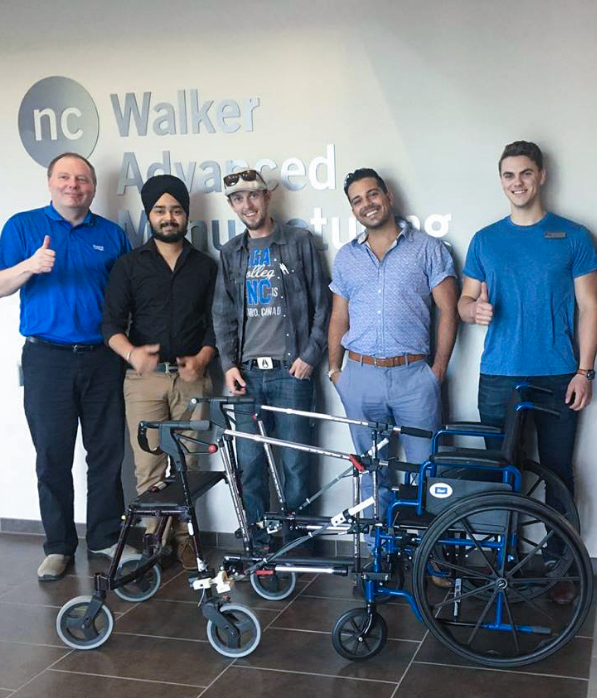
WAMIC and Bisep team pictured in front of their ARMM wheelchair device.

Members of the ARMM project research team gather with the team at NC’s Walker Advanced Manufacturing Innovation Centre (January 2020).

The success of that early project set Bisep on a path of continued innovation and growth, laying the foundation for a meaningful health technology success story.

“Niagara College gave us our start,” says Bordenave. “Before that partnership, we had an idea. After that project, we had a business. The team at WAMIC took what was in my head and turned it into something real, a prototype I could test, refine and bring to market.

“That first prototype didn’t just prove the concept—it opened the door to funding, clinical research and, ultimately, the creation of a company.”

WAMIC’s engineers and research students worked alongside Bisep through every stage of development. They helped move the concept from sketches to a fully functional prototype of the ARMM device. The collaboration provided access to advanced equipment, prototyping tools and engineering expertise that would have been out of reach for a small startup.

“The best part about working with Niagara College was how invested they were in our success,” Bordenave recalls. “It wasn’t just technical help. They asked questions, offered suggestions and pushed us to think differently. It felt like they were part of our team.”

That early partnership also introduced Bisep to the broader Southern Ontario Network for Advanced Manufacturing Innovation (SONAMI), an NC-led consortium of post-secondary schools and ecosystem partners that helped the company secure funding and industry connections. “The support we gained through Niagara College and SONAMI opened doors we couldn’t have imagined,” says Bordenave. “It’s what allowed us to attract investors, run clinical trials and eventually commercialize our product.”

Today, that relationship continues in meaningful ways. Bisep films its training and demonstration videos in Niagara College’s mock nursing ward, showing how the device functions in real healthcare settings. Students from the Occupational Therapist and Physiotherapist Assistant program also use the device in their labs, gaining hands-on experience with new rehabilitation technology.

“We owe a lot to Niagara College,” says Bordenave. “They helped us move from a local prototype to a national product, and they’ve stayed in our corner the whole way.”

See the project in action

Research & Innovation’s engineering team help with innovative medical technology

WAMIC helps local start-up Bisep Inc., with their device that connects a patient’s wheelchair to their walker so they can move unaided. The device, named the ARMM (Ambulation, Retraining, Mobility, and Mechanism), is demonstrated by Yodha Singh, Mechanical Engineering student at Niagara College.

Building Compassion and a Commitment to Care

The success of that first prototype was only part of the story. Behind the innovation was a personal experience that began years earlier in a long-term care home in St. Catharines, where Bordenave worked while completing his studies. There, he saw just how transformative movement could be. Residents who walked regularly seemed more confident, while those who couldn’t often became withdrawn. For many, the ability to take a few independent steps wasn’t just exercise; it was freedom.

“I invented the device for one patient,” he recalls. “She would ask me every day to go for a walk, but because she was a two-person assist, I couldn’t take her on my own. That frustration—seeing someone lose mobility simply because we didn’t have enough support, was the inspiration.”

That experience stayed with him. He began to wonder how a single tool could make it easier for both patients and caregivers to work together safely without needing multiple staff for each walk. The idea wasn’t about replacing care but about making care more accessible. “I just wanted to make it possible for people to move more often,” says Bordenave. “If they could walk every day instead of just twice a week, their health and outlook could change completely.”

Working evenings and weekends, he started sketching ideas for a device that could bridge the gap between wheelchairs and walkers, something simple, practical and adaptable to different users. Those early prototypes were basic, but they captured the essence of what Bisep would become: technology rooted in empathy through a company dedicated to improving the quality of life for aging adults and individuals with mobility challenges.

From Local Prototype to National Impact

Since partnering with Niagara College, Bisep has rapidly evolved from an early-stage prototype into a fully commercialized medical technology.

The company has expanded its research collaborations, earned national recognition through multiple innovation awards, and built a strong advisory board to support its growth. Full commercialization began in 2025, and the company quickly secured distributors across Canada, driving strong market adoption and continued momentum rooted in the foundational development work completed with NC.

We want to create tools that keep [people] moving and connected to their communities. The longer someone can stay mobile and confident, the better their overall quality of life.

Daniel Bordenave, CEO, Bisep

Evolving the Design: Listening, Learning, and Leading

As Bisep moved from prototype to production, the company entered what Bordenave calls the “learning phase:” a time defined by collaboration, humility, and constant iteration. From the beginning, the guiding principle was simple: listen to the people who use it.

“Early on, we learned that healthcare professionals don’t have time for complicated equipment,” says Bordenave. “They want something that works right away, no tools, no adjustments, just intuitive design.”

Initial clinical trials and pilot programs, including one with Perley Health in Ottawa, confirmed the strength of Bisep’s concept but revealed areas for improvement. That feedback ultimately led to the creation of a universal attachment system that fits more than 90 percent of manual wheelchairs on the market and can be set up in under 30 seconds. “It seems like a small change,” Bordenave notes. “But it made all the difference. Therapists who were hesitant before are now excited to use it. They see that it saves time, keeps patients active, and makes their work easier.”

Each refinement brought Bisep closer to its goal of creating a truly universal mobility aid. The redesign also marked a turning point for the company’s intellectual property (IP) strategy. Building on lessons from its early NC partnership, Bisep secured four patents, including a new universal clamp design, and received nearly $100,000 in IP funding through Intellectual Property Ontario (IPON) and Elevate IP.

“These programs gave us the tools to protect what we built,” says Bordenave. “But more than that, they allowed us to keep innovating. When you know your ideas are protected, you can focus on improving them.”

Restoring Independence and Quality

At its core, Bisep’s story is about more than engineering or commercialization; it’s about people.

“Our goal is to help people age in place,” Bordenave explains. “We want to create tools that keep them moving and connected to their communities. The longer someone can stay mobile and confident, the better their overall quality of life.”

That same philosophy continues to guide the company’s future research and development. Bisep is exploring new products that support mobility and rehabilitation at home, building on the same mix of empathy and practicality that shaped its first innovations.

“It all comes back to compassion,” says Bordenave. “Technology is only meaningful when it improves someone’s life. If what we create helps a person feel capable again, if it makes them smile or gives them back time with their family, that’s success to me.”

Looking Ahead

As Bisep looks ahead, the company is focused on continued growth—expanding sales, strengthening partnerships and advancing new technologies that support aging and rehabilitation. “We’re excited about the next stage of development and the opportunities to scale our impact,” says Bordenave.

To learn more about Bisep, visit bisepinnovations.com.

If you’re interested in how Niagara College helps companies like Bisep accelerate innovation—from early prototyping and product refinement to testing, validation and commercialization— visit the research website reach out to David DiPietro, Business Development Manager.

This project was supported through funding from the Federal Economic Development Agency for Southern Ontario (FedDev Ontario), which helps connect industry partners with the expertise, technology and talent needed to accelerate innovation.

Date

Apr 10, 2026

Type

E-Newsletter

Project Successes

Sector

Advanced Manufacturing