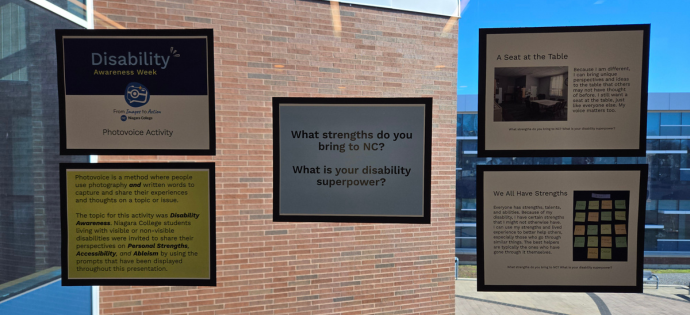
Most recently, the Photovoice project turned its focus to students with visible and non-visible disabilities. Using announcements in the NC Engage app and on-campus promotional channels, they were invited to submit photos that would showcase their thoughts and feelings on accessibility, ableism, strengths, visible and invisible disabilities, what makes them feel empowered or supported, but also places that make them feel comfortable or uncomfortable.
The creative and engaging responses were printed out and made available during two sessions as part of Disability Awareness Week, on March 9 at the Welland campus, and March 11 at the Daniel J Patterson campus.
“Photovoice is a powerful tool, not only for those who take photos and write the captions that accompany their pictures, but also for those who view the images and words,” said Christine Wilkinson, one of the project researchers, and current researcher with the Healthy Aging and Wellness Innovation Centre (HAWIC).
“The college staff who took part in the exhibitions were all profoundly moved by what the NC students shared via their pictures and narratives, leading to new insights and suggestions for how to enhance the NC experience. The student participants were grateful for the opportunity to share their perspectives with the college,” Wilkinson added. “While only 4% of NC student participants had heard of Photovoice before, 96% of them said they would recommend taking part in a future Photovoice project to a friend.”
To finish off the project, and also in the vein of continuous improvement, the research project team is working on a ‘how-to’ manual, so that any college groups who are interested in this type of engagement can lead their own Photovoice project.
“As a graduate of the Recreation Therapy program at Niagara College, having the opportunity to work on multiple Photovoice projects as a Research Assistant has been extremely valuable, as the philosophy behind this tool directly compliments the knowledge I have gained through my program of study,” noted Matt Bornich, currently a HAWIC research assistant.
“By working on both the Photovoice projects for academic success and for EAP student experiences, I have learned that Photovoice is not just a wonderful medium for self-expression and exploration among individuals, but also an effective and versatile research tool for gathering qualitative data that can help promote change across a variety of real-world issues.”
To learn more about the current work of the Healthy Aging and Wellness Innovation Centre, visit the website, or contact David DiPietro, Business Development Manager.